:format(webp))
The Equity Walk: A Required Exercise for K-12 Athletic Administrators
The athletic administration profession is often subject to increasing responsibilities and ever-changing demands. Title IX, athletic equity compliance, is one athletic administration responsibility that continues to create challenges for professionals across the field.
While overall Title IX compliance is the responsibility of the school’s or district’s Title IX coordinator, athletic administrators can and should positively contribute to their school’s Title IX compliance process. Athletic administrators are in a prime position to assist their school’s Title IX coordinator in achieving athletic compliance by engaging in an annual exercise known as an equity walk.
Title IX requires schools to provide equal athletic opportunities for female and male students and equitable treatment of participants in female programs compared to male programs. The equity walk assists in analyzing the components of the equitable treatment of participants, also commonly referred to as the “Laundry List,” broken down into the 11 components outlined in Figure 1.
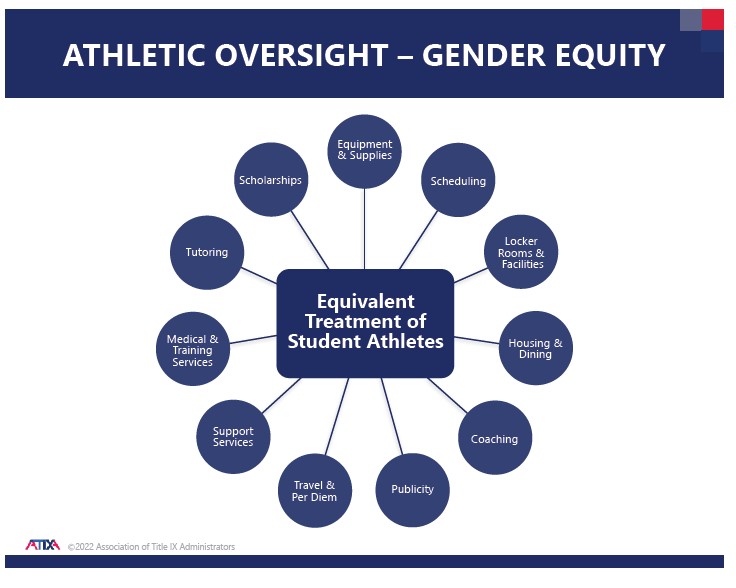
The equity walk entails athletic administrators physically touring or walking their entire athletic facilities while visually assessing two of the 11 components: Locker Rooms & Facilities and Equipment & Supplies. Equity walks are typically done by the athletic director and the Title IX coordinator. However, superintendents, school board members, and gender equity committees can also participate in the equity walk with the Title IX coordinator. Regardless of who completes the equity walk, the Title IX coordinator should be a part of the process.
Locker Rooms and Facilities
When assessing locker rooms and facilities, examine the following key factors:
• Quality and availability of the facilities provided for practice and competitive events: Title IX compliance requires that the quality of facilities be the same for male and female athletes. Athletic administrators want to pay close attention to facilities designated for single-sex use, for example, baseball and softball fields and stadiums. The quality of both fields and stadiums, dugouts, restrooms within the stadium, if applicable, etc., should be relatively equal, respectfully considering the different requirements for each sport when you have single-sex use facilities. For the sports that share facilities, such as male/female basketball, and volleyball, Title IX requires an equal opportunity to use shared facilities for practices and competitive events.
• Exclusivity of use of facilities provided for practices and competitive events: Schools should not have a facility only available to a single-sex sport without a comparable facility for the other sex. Title IX requires that exclusive facilities for practices and competitive events be made available equally to male and female athletes.
• Quality and availability of locker rooms: Similar to the first bullet point above, the quality of single-sex locker rooms should be equal between male and female athletes. For schools where locker rooms are shared between male and female athletes, athletic administrators should ensure that male and female athletes have equal opportunities to use the locker rooms. Generally, this can be easily accomplished by having a rotating schedule of locker room use between male and female athletes.
• Maintenance of practice and competitive facilities: Athletic facilities should be maintained regularly to ensure athlete safety and success during practices and competitive events. Athletic administrators should ensure that all facilities are maintained appropriately (e.g., use of quality materials, cleaning products, upkeep, etc.), regardless of the sex that uses the facility.
• Preparation of facilities for practices and competitive events: Athletic administrators should ensure that the facilities athletes use for practice and competitions are safe and appropriately prepared for practices and competitive events regardless of the athletes’ sex. Pay attention to who is preparing facilities for practices and competition, how the facilities are prepared, how much time is needed to prepare the facility, and what is required to prepare the facility. Whoever is responsible for facilities preparation should perform their duties for male and female athletic teams equally and based on the facility’s needs.
Equipment and Supplies
There are five factors to examine under equipment and supplies; however, only two are a part of the equity walk: quality of equipment and supplies, and amount of equipment and supplies.
• Quality of equipment and supplies: While internet searches can provide information specific to the quality of equipment and supplies, visual assessments of each piece of equipment and any supplies is necessary to ensure a proper maintenance schedule and timely replacement. Title IX requires that the quality of equipment and supplies be equal for male and female athletes, depending on sports’ specifics. For example, male track and field athletes should not be provided name-brand uniforms (e.g., Nike, Adidas, etc..), while female track and field athletes are provided off-brand uniforms.
• Amount of equipment and supplies: It is necessary to physically count equipment and supplies during the equity walk to ensure accurate records. Title IX requires that equipment and supplies be provided equitably for male and female student-athletes, meaning that the number of supplies and equipment can fluctuate between male and female athletes based on roster size and actual participant numbers. However, there should not be significant discrepancies, such as one sex getting two uniforms and the other sex getting one.
When completing an equity walk and there is evidence of inequities within the athletic program, first communicate with your school’s Title IX coordinator and devise a plan of action for creating equity where inequities exist. It is important to note that creating equity where inequities exist is not an overnight fix and might entail strategic planning. Creating a solid strategic plan on gender equity in athletics, in partnership with the school’s Title IX coordinator, and following the strategic plan is the best practice for maintaining an equitable athletic program. Additionally, strategic planning can guide future facilities planning, management and remodeling.
Aristotle once said, “We are what we repeatedly do. Excellence then is not an act but a habit.” The work of athletic administrators is indeed demanding; however, athletic administrators who repeatedly engage in the equity walk can model excellence in athletic gender equity while assisting the Title IX coordinator with eliminating any gender inequities within the school’s athletic program.
Related Stories
:format(webp))
:format(webp))
:format(webp))
:format(webp))
:format(webp))
:format(webp))
:format(webp))