:format(webp))
In Support of the American Development Model in High School Hockey
Recently, the four major NCAA Hockey programs in the state of New Hampshire came out in support of USA Hockey’s American Development Model (ADM). USA Hockey established the ADM for all levels of youth hockey in 2009, using comprehensive research from hockey experts, sports scientists, and child development specialists from around the globe. The ADM is a drastic change in the way that we teach hockey to young players, and it has been met with some resistance from parents and coaches alike. As a high school hockey coach, I can tell you that the program is a smashing success.
I recently went to a coaching seminar cosponsored by the Boston Bruins and USA Hockey. As a disclaimer, I am neither a member of USA Hockey nor its governing body, so I was attending the seminar for purely academic purposes. I came out of the day-long program with a new appreciation for what USA Hockey has done in the past five years, particularly in changing how we teach the game.
When I was a young player in the 1980s, most of our coaching was done by parents and volunteers who were certified by USA Hockey, and inspired in large part by what those parents were taught as players in the 1960s and 1970s. There were Lots of waiting in line, “down the ice and back” drills and game play, in addition to the occasional skills or power skating practice. Today’s player demands more touches and more skill development, or they inevitably give up on hockey. The American Development Model focuses on small area games at practice, focused skill development, and half-ice games for younger players, all of which develop high activity levels and an age-appropriate experience.
Obviously, high school hockey players are not playing cross-ice hockey. The size and speed at which high school players are playing the game is greater than even 10 years ago, but USA Hockey’s ADM has found ways to incorporate the age 14 to 18 players. Small area games are part of every good high school hockey practice. Some coaches have been doing these drills for years, but they haven’t realized it. Small area games are any practice drill that takes place in a portion of the rink, focuses on developing a skill in a tight area, and has a results-oriented outcome (team A scores, the drill ends). Small area games are vital in the development of high school hockey players.
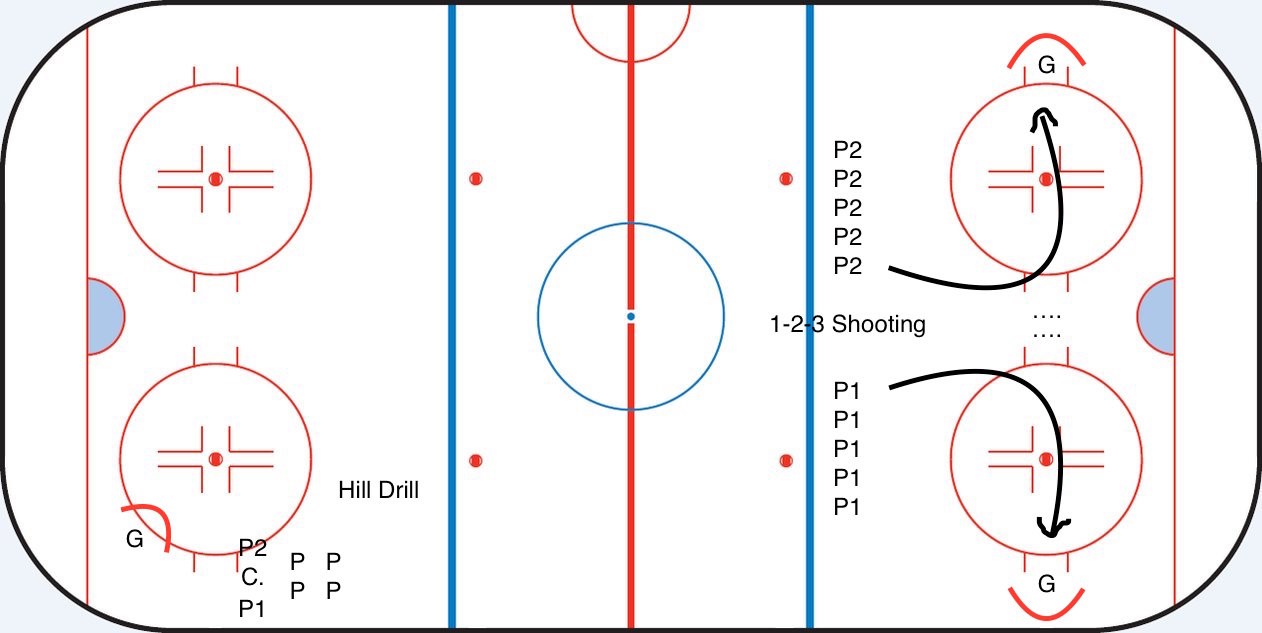
Here are two great examples of small area games that could be used in practices and incorporated into game play that show immediate dividends. The first, called Hill Battle after our assistant coach who developed it, is a corner battle drill that includes two skaters of any position (preferably players of the same physical stature) and a goalie. The two players line up on the hash marks on the boards in the zone. The net is placed on the edge of the circle by the goal line. The coach will flip the puck into the corner area and the two players battle for possession. When one gains possession, they are free to shoot. The other player is also free to get the rebound and shoot again. The drill goes as long as the coach wants. I usually let it play out for about fifteen seconds of board battling and shots, tossing in new pucks as needed. After fifteen seconds or so, I blow the whistle and the players race to the near blue line and back into the line to add conditioning.
The second drill is a full team competition drill that incorporates a ton of shooting and passing, and builds team camaraderie, which we call 1-2-3 shooting. Players line up across the blue line in two lines with the middle of the line being the starting point, and a pile of pucks are placed between the circles. Both nets are placed on the hash marks against the boards with a goalie in each net. Players on the blue line divide into two groups. One at a time, each line sends a player skating into the puck area where they pick up a puck and skate in to shoot on the goalie. If they score, their line sends out two players at the same time for a 2-on-0 against the goalie. If they score, their line would send three players for a 3-on-0 against the goalie. If at any time their line doesn’t score, it goes back to one shooter for a 1-on-0 against the goalie. The first team to score on a 1-on-0, a 2-on-0 and a 3-on-0 in a row without having to restart, wins the drill and gets one point. The first team to three points wins the drill, and the other side does pushups or another appropriate activity.
Most high schools aren’t as fortunate as ours; we practice directly after school at 2:30 p.m. It’s easy to engage my players in drills because they are still focused and alert from their school days. For schools practicing in the early morning, small area games are exactly what is needed to engage players in meaningful activity during practice. Hockey is also a “different” sport, with our early and late hours, but we’re different in another way. Most teams have only 50 or 60 minutes a day of on ice practice three to four times a week. Because of this, small area games become paramount. They are explained easily, players take to them quickly, and they encourage multiple touches and reps. Players also can’t “take a drill off” because they’re competing in small space and the incentive to “win the drill” pushes them to be successful.
With more and more players leaving traditional education-based athletics for pay to play junior programs, we as coaches must use the latest techniques in skill development so that players will be ready to play at the next level. Gone are the days of “down and back” drills. Small area games and the American Development Model are showing great results in team play, skill development, and engagement of players at practice. For more information on small area games and the American Development Model, check out www.admkids.com.
Related Stories


:format(webp))