:format(webp))
Risk vs. Reward: Sport Specialization in Interscholastic Athletics
Sport specialization within interscholastic and youth sports continues to be a much-discussed topic by school administrators, athletic directors and interscholastic coaches.
Increasingly, the mindset of many young athletes and their parents is that the best way to improve a student’s opportunity for playing time, attention from college coaches and pro scouts, a scholarship offer, or perhaps millions of dollars in Name, Image, Likeness (NIL) endorsements is to be very good at a single sport. There is great risk with this mindset and often it outweighs any reward that the student or family may realize.
In an article entitled Revisiting Early Sports Specialization: What’s the Problem? Mosher, et, al point out that “the average age for sport specialization is about 14 years and is, therefore, during a crucial stage...early adolescence.”1 The notion of early specialization stems from the “deliberate practice framework”1 which emphasizes the idea that the more you practice and play a specific sport, the better you become at that sport. While there is support for some elements of this framework, there also is large body of evidence suggesting early specialization is not a strong indicator of future success in the sport.1
One of the largest areas of concern surrounding specialization is injuries. Recent research has clearly shown that athletes who are highly specialized “are at greater risk of serious injuries and are more likely to report a previous injury.”1 Often, these injuries occur while athletes are participating in athletic activities that are outside of the interscholastic umbrella, but bring their injuries into the interscholastic realm by seeking care for their injuries from athletic trainers and other medical providers affiliated or employed within their schools.
In addition to the negative physical outcomes of specialization, there is also an ongoing concern about the negative psychological outcomes of specialization. Studies have indicated that adolescents who specialize in a specific sport experience “psychological needs dissatisfaction and emotional exhaustion”.1
Burwell, et. al., found in a study published in 2022 in the Journal of Sport Rehabilitation, an “association between highly specialized athletes and an increase in injuries as well as a connection between injury and lower health-related quality of life (HRQOL)”.2 The study further found that those athletes who began to specialize in sport at a younger age had a lower HRQOL than those who specialized later in life, such as after entering college to play a sport.2
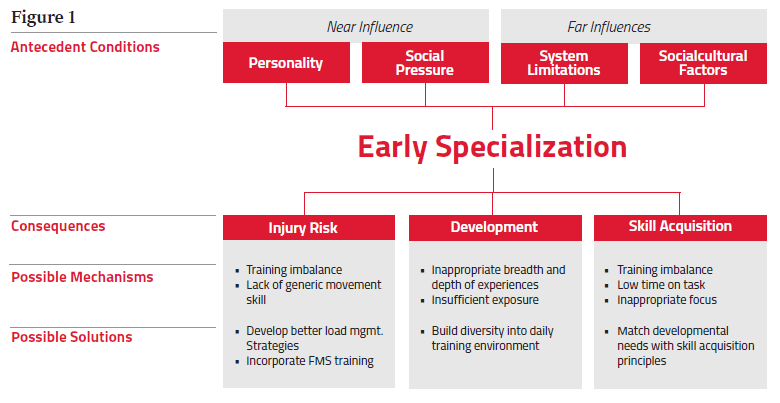
Mosher, et. al, have developed an interesting framework for exploring early sport specialization. On the horizontal axis of the framework, they look at three consequences: injury risk, development and skill acquisition.1 On the vertical axis they look at the possible mechanisms under each area of concern and include possible solutions. (See Figure 1 below)
It is clear that the growing acceptance of sport specialization has led to an equally growing concern among all of the stakeholders within the interscholastic community. Cesar R. Tores in a paper published in 2015 points out that there are several fundamental philosophical issues that are raised by early sport specialization.3
Primary among these issues is the right of children to an open future. Parents legitimately have parental authority when it comes to decisions that are intended to promote their children’s interests. Tores notes, however, that “parental authority is not absolute and might be restricted to protect children’s right to an open future.” In this regard, Tores argues, “education is crucial in keeping children’s future open.” 3
Another fundamental philosophical area of concern is the uniqueness of early specialization in dangerous sports. These sports are defined as those that involve activity that “creates significant risk of loss of, or serious impairment to, some basic capacity for human functioning which include living through the typical life span, having good health, being able to ambulate freely, and using the senses for purpose such as reasoning and imagining”.3 Sadly, parental judgment may become clouded to these issues in their effort to find success for their children. Likewise, there is no easy solution to this moral dilemma.
The third philosophical area is the challenge of competition and coaching in early sport specialization. Coaches must be willing and able to take on the moral and professional responsibilities when addressing specialization. Most important is for coaches to recognize and promote the philosophy that competitive sport also “embodies important values such as respect, equality, fairness, cooperation, and excellence.” Furthermore, coaches “should be fully and critically aware of the moral tensions and ambiguities inherent to competitive sport.”3
This leads to the ultimate question for school administrators, athletic directors and interscholastic coaches, which is how to proceed? First, should be education for athletes, parents and coaches on the potential detriments that are associated with early sport specialization to allow stakeholders to make informed decisions regarding participation.2
Second, school districts and schools should develop programs to minimize and manage the risks. This includes establishing an appropriate environment focused on promoting positive and reducing negative health consequences for student-athletes.1
Third, monitor and evaluate athletes. “Having a clear approach to monitoring and evaluation can serve several purposes with adolescent athletes, including informing needs analysis and talent identification as well as evaluating the effectiveness of training programs” both inside and outside of the interscholastic program.1
Fourth, implement integrative neuromuscular programs. “Integrative neuromuscular training programs allow the development of concepts of athleticism (i.e., the ability to repeatedly perform a range of movements with precision and confidence in a variety of environments, which require competent levels of motor skill, strength, power, speed, agility, balance, coordination and endurance and are associated with enhanced athletic qualities and reduction in negative consequences.)”1
Early specialization in athletics is an important policy issue for school administrators, athletic directors and coaches, and there is no indication that this will change in the near future. It is incumbent then upon all stakeholders to understand the physical, psychological and social implications this topic holds for student-athletes in the 21st century.
References:
Mosher, Alexandra, et al. “Revisiting early sport specialization: what’s the problem?.” Sports Health 14.1 (2022):13-19.
Burwell, Matthew, Justin DiSanti, and Tamara C. Valovich Mc- Leod. “Early sport specialization in college athletes and the impact on health-related quality of life: a critically appraised topic.” Journal of Sport Rehabilitation 31.5 (2022): 645-650.
Torres, Cesar R. “Better early than late? A philosophical exploration of early sport specialization.” Kinesiology Review 4.3 (2015): 304-316.
Related Stories
:format(webp))
:format(webp))
:format(webp))
:format(webp))
:format(webp))
:format(webp))
:format(webp))