:format(webp))
Applying Marines Leadership Principles in an Athletic Department
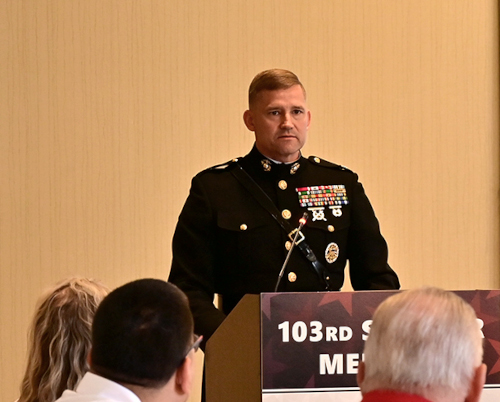
Military metaphors abound in the world of sports. But, while references to a coach leading a team into battle and warriors leaving it all on the field can be overused and cliché, useful parallels do exist whether one is leading a military unit or a high school athletic department.
Col. Michael Reilly, a 26-year U.S. Marine and professor of the Naval Reserve Officer Training Corps Unit at Texas A&M University, believes that leading a diverse group of individuals – on the battlefield or in a high school – requires similar traits and strategies. Common principles found within the Marine Corps can be applied to creating a successful athletic department.
“One of the benefits of being in the military, which probably is very similar to that of being a coach or athletic director, is you’re always going to be around highly diverse groups of people,” Reilly said. “You can get strength out of that and there are, of course, challenges that come along with that.”
Foundational Principles
As athletic directors lead their coaches and teams, Reilly notes that there are three fundamental characteristics they should employ to motivate them. First, athletic directors must have a clear vision of what constitutes a successful athletic program.
“First and foremost, ‘why are you there?’ What is the purpose of your organization,” Reilly said. “Without that, everybody will be doing their own thing.”
Second, a common set of standards for behavior and performance need to be in place, and they must be enforced evenly and unemotionally.
Finally, a department must define the core values by which it operates.
“In the Marine Corps, we list honor, courage and commitment as our core values. All of our standards are foundationally built upon those core values,” Reilly said. “If you can’t articulate what your values are, it will be difficult for your people to understand how to behave. When I see ineffective leaders, usually the leader has not taken the time to identify the vision, standards and values effectively.”
Model Behavior
Once a clear vision and values have been effectively communicated, an athletic director must then model those values, setting an example for others in the athletic department. It’s the same principle in a military setting, Reilly says. A commander cannot expect his or her subordinates to do anything that the leader will not do, whether that is completing a certain task or making the right moral decisions.
Reilly notes that high school athletic departments often state that success is measured not by wins and losses, but by the lessons student-athletes learn through participation. However, if an athletic director or coach emphasizes winning at the expense of those stated values, that is a problem.
“I’m a father of a student right now that plays high school athletics. Within that team, is it the feeling of the coach that they are there to win at all costs? If so, there is an ethical problem with that athletic department,” Reilly said. “If they are there to win at all costs, that could lead to all kinds of ethical and moral problems. By modeling this behavior, what is that teaching kids? That behavior gets interpreted as those values aren’t important.”
Consistent Communication
According to Reilly, when he started commanding organizations, he made sure his vision and values were clear and understood all the way down the chain of command. An athletic director should strive for the same goal, communicating with not just head coaches, but assistant coaches, trainers, players and parents.
One strategy he employed to accomplish this goal was to repeatedly and consistently communicate his core values in every engagement with his subordinates.
“Whenever I’m among my students here at the university, I will always talk about values,” Reilly said. “When they associate me with a speech, they should expect to hear about values.”
If a leader is consistently and effectively communicating the organization’s shared set of values, then everyone – from the top to the bottom – should be able to communicate those values in return.
“There’s an old-school military trick called ‘Napoleon’s Corporal.’ When Napoleon wanted to see if his orders were being transmitted properly, he would find one of the lowest-level soldiers and ask what the mission was and why they were doing it. If the soldier was able to correctly provide Napoleon with the mission, he knew he had an effective leadership team,” Reilly said.
Decision-Making
Even if a leader is successful in creating a principle-based environment and receiving buy-in from the rest of the department, eventually circumstances will require hard decisions to be made. Athletic directors may not make the same type of decisions that a U.S. Marine does, but Reilly explains that the same decision-making strategies can be used in both environments.
A deliberate decision-making process allows for the gathering of information, collecting feedback from others and creating a consensus. An intuitive or experience-based decision must be made sooner. Therefore, determining the time available to make a decision is vital, Reilly says, and is one of the first things he asks: how much time do I have?
“What I’ve found is usually, you have a little more time to make a decision than you think you do,” he said. “That time gives you the opportunity to ask the right questions in order to get the right information to make the decision appropriately.”
Taking the appropriate amount of time before making a decision is critical, because once a decision is made, it is hard to pull it back without losing some credibility. Reilly suggests that individuals asking for a decision communicate how much time is provided before that answer is actually needed.
“In the Marine Corps, it is called the ‘decision space.’ That’s the time between being presented with a problem and the time a decision is needed,” Reilly said.
An Environment of Success
Reilly believes a leader’s role is to create the right environment for his or her people to succeed at their tasks. Ultimately, athletic directors must ensure their decisions are in the best interest of the student-athletes, coaches and staff, and set them up for success.
“If the big picture is how we are mentoring and developing character in these young men and women, who we have the privilege of spending time with, then, ‘am I creating the right environment for that to happen?’” Reilly said.
It’s a question all athletic directors must ask themselves, Reilly says, because of the important role they play in the development of our nation’s youth.
“Once all the championships are over, the intangibles and the character are what students take with them. That’s what is so important about high school sports and that’s what’s so important, in my mind, about the Marine Corps. Our country needs young men and women of character.”
To learn more about Marine Corps leadership principles and how you can partner with the Marines in your local community, please visit RMI.Marines.com/Influencer.
Related Stories
:format(webp))
:format(webp))
:format(webp))
:format(webp))
:format(webp))
:format(webp))
:format(webp))